
Complete Guide to Online Payments for Your Store: Payment Methods, Processors, and How to Pay by Card


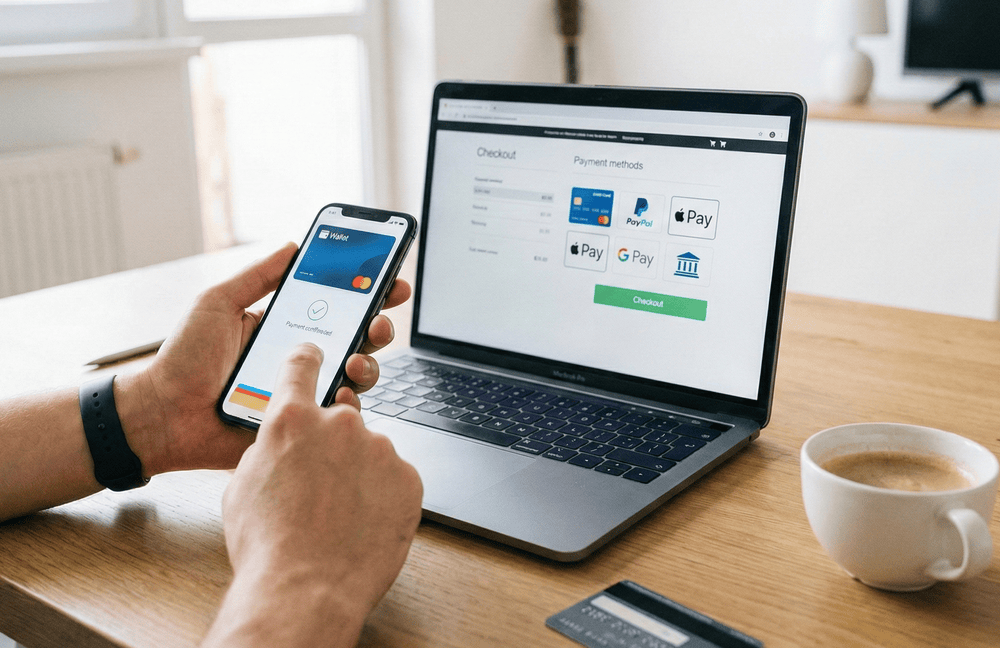
In e-commerce, online payments are not just "another feature," but an element that directly influences conversions, trust, and order completion rates. In this guide, you'll understand: what payment methods are worth offering in Romania, how a payment processor works, what payment security means (SSL, 3D Secure, anti-fraud), and how to optimize checkout for more orders and fewer abandonments.
What you'll find in this article:
- how online card payment works and how to make it safer
- the most used online payment methods in Romania (card, wallet, transfer, PIS, installments)
- what an online payment processor does and why it matters for conversion
- clear criteria for choosing a payment gateway
- how to properly integrate payments in your store (UX, testing, fallback, optimization)
How to Pay by Card Online Safely
Online card payment is safe when a few simple but essential conditions are met. First, check if the site has a secure connection (HTTPS + padlock in browser) – this indicates the use of an SSL certificate and encryption of transmitted data.
Quick checklist for buyers:
- The site has https:// and a padlock (active SSL)
- The store has identification data (company, contact, clear policies)
- 3D Secure is used (confirmation via app / SMS / biometrics)
- You don't pay from public Wi-Fi (or you use a VPN)
- You have alerts (SMS/push) for card transactions
Why does 3D Secure matter? Because it adds an authentication step that reduces fraudulent use of the card. Additionally, in many cases, it also helps the merchant reduce dispute risks.
Online Payment Methods Available in Romania
In Romania, consumers use a combination of classic and "new" methods, and a store that wants good conversion should check at minimum: card + cash on delivery + transfer (and, ideally, a PIS / wallet alternative).
| Method | When It's Preferred | Advantage | Risk / Limitation |
|---|---|---|---|
|
Card (Visa/Mastercard) |
Most orders |
Fast, familiar, good conversion |
Requires well-optimized checkout |
|
Digital wallets (e.g., PayPal / wallets) |
Customers who want "no card data" |
Convenience + privacy |
Not all wallets are equally popular in niches |
|
Bank transfer |
B2B / large orders |
Clear, "traditional" |
Slower, more friction |
|
PIS (open banking) |
Customers who prefer paying directly from account |
Modern, efficient flow |
Variable adoption depending on audience |
|
Cash on delivery |
Trust on first order |
Reduces barriers for new customers |
Costs/returns harder to control |
|
Installments / BNPL |
Large carts |
Increases AOV |
Depends on partnerships and conditions |
For modern transfers based on open banking, you can check out our payment initiation service (PIS).
How Payment Methods Influence Conversion Rate
Choosing online payment methods is not just a technical decision, but one directly linked to the store's commercial performance. E-commerce studies show that the lack of preferred payment method is one of the main causes of cart abandonment.
For example, in Romania, cash on delivery remains relevant for certain audience segments, while online card payment is preferred by urban customers accustomed to digital payments. Electronic wallets and open banking payments are rapidly gaining ground among young users and those seeking speed and simplicity.
- Online card – increases order completion speed
- Digital wallets – reduce friction and security concerns
- Bank transfer / PIS – suitable for high-value orders
- Installment payments – increases average cart value
A well-chosen mix of payment methods can increase conversion rate by 10–30%, without additional investment in traffic.
Online Payment Processor: How It Works and Why It's Important
An online payment processor (in tandem with a payment gateway) manages the technical flow between the store, customer, and issuing bank: authorization, confirmation, anti-fraud, and settlement. Everything happens in a few seconds, and the quality of this flow directly influences conversion rate.
In short, the payment flow:
- Customer chooses the payment method and enters data
- Gateway securely transmits the request to processor/bank
- Bank authorizes (possibly with 3D Secure)
- Transaction is confirmed and order is completed
- Funds are settled to the merchant according to schedule
For context and selection criteria, check our internal guide: what is a payment gateway and how to choose the right one.
Why does processor choice matter?
- Conversion: fast checkout + good approval rate = more orders
- Security: PCI DSS, tokenization, anti-fraud, 3D Secure
- Operations: reports, reconciliation, notifications, dispute management
- Scaling: international payments, multi-currency, new methods
Payment Gateway vs Payment Processor – What's the Difference
In common usage, the terms payment gateway and payment processor are often used interchangeably, but from a technical standpoint, there are important differences.
The payment gateway is the component that collects and transmits payment data in a secure manner, while the processor manages transaction authorization, communication with banks, and the actual transfer of funds.
In practice, most modern solutions offer an integrated system that fulfills both roles, simplifying implementation for merchants and reducing the risk of technical errors.
For an online store just starting out, choosing an all-in-one solution reduces operational costs and launch time, while providing support for multiple payment methods and advanced security features.
Choosing the Right Payment Processor for Your Store
When choosing a payment processor, the most common mistakes are made in two directions: (1) comparing only the commission, without considering conversion and stability; (2) integrating too many methods and making checkout confusing.
Evaluation criteria (practical):
- Total costs (not just commission): setup, transactions, chargeback, currency conversion
- Payment methods relevant to your audience (card + alternatives)
- Stability: uptime, speed, approval rate
- Integration: plugins / API, documentation, technical support
- Reporting: exports, reconciliation, accounting integration
- Security: PCI DSS, anti-fraud, 3D Secure, tokenization
Integrating Payment Methods in Your Online Store
Before the actual integration of payment methods, it's important to analyze the complete customer journey, from site entry to order confirmation. A checkout that's too complex or unclear can negate the advantages offered by the best payment solutions.
Optimizing this flow must account for user behavior on both desktop and mobile, where over 60% of online transactions are currently initiated.
Integration doesn't just mean "making it work." It means making it work well: fast, without errors, without unnecessary steps, with a clear experience on mobile.
Implementation recommendations (conversion-friendly):
- In checkout, display 2–4 options maximum (you can hide the rest under "Other methods")
- Set card as the main option, but also keep an alternative (PIS/transfer/cash on delivery)
- Reduce form fields (auto-complete, clear validation, explicit errors)
- Test on mobile: loading time, buttons, scroll, return to cart
- Have a backup plan: if method #1 fails, the customer should be able to pay differently
| Common Problem | Impact | Solution |
|---|---|---|
Checkout too long |
Cart abandonment |
Fewer fields + guest checkout |
Unclear payment errors |
Distrust |
Explicit messages + retry + another method |
Difficult payment on mobile |
Poor conversion |
UX optimization + page speed |
Too many methods |
Difficult decision |
Prioritization + "Other methods" |
Online Payment Security: Data Protection and Fraud Prevention
Online payment security is a mix of technology + procedures. SSL alone isn't enough; you also need anti-fraud measures, monitoring, and clear policies.
Minimum recommended for stores:
- HTTPS + SSL
- 3D Secure for card payments
- Tokenization (where applicable) and avoiding storing card data on server
- Anti-fraud rules (e.g., multiple attempts, suspicious IP, atypical carts)
- Logs and alerts for abnormal transactions
Chargebacks and Fraud: What Every Online Merchant Should Know
An often underestimated aspect of managing online payments is chargeback risk. This occurs when a customer disputes a transaction, and the amount is temporarily or permanently withdrawn from the merchant's account.
Chargebacks can arise from legitimate reasons (fraud, undelivered product, unprocessed return), but also from errors or abuse. A high number of disputes can affect the relationship with the payment processor and can lead to higher fees or even account suspension.
- clear product descriptions
- visible and easy-to-understand return policies
- delivery proofs and order confirmations
- anti-fraud systems and active 3D Secure
Proper management of these risks is essential for the financial stability of the online store and for maintaining a healthy relationship with payment service providers.
Current Trends in Online Payments and Final Recommendations
In 2026, the major trend is payment simplification: fewer steps, more "one tap," more mobile-first. In parallel, anti-fraud is becoming smarter, and account payments (open banking / PIS) are growing in interest for certain segments.
Final recommendation (practical):
- Offer card + one more solid alternative (PIS/transfer/cash on delivery)
- Optimize checkout for mobile before any ad campaign
- Track metrics: payment approval rate, checkout abandonment, mobile errors
- Review monthly the real costs vs conversion (not just the commission)
Frequently Asked Questions About Online Payments
1) Is it safe to pay by card online?
Yes, if the site has HTTPS/SSL, uses 3D Secure, and you avoid public networks. Enable transaction alerts and periodically check your statement.
2) What payment methods should an online store in Romania have?
The healthy minimum: card + cash on delivery + transfer. Ideally: also add a modern alternative like PIS (payment initiation), depending on audience.
3) What is a payment processor / payment gateway?
It's the infrastructure that authorizes and processes the transaction, secures the data, and manages settlement. Details: what is a payment gateway.
4) What costs should I track with a processor?
Commission per transaction, setup/maintenance fees, chargeback costs, currency conversion, and impact on conversion. See also: gateway fees.
5) How do I increase checkout conversion?
Reduce steps, clarify errors, optimize for mobile, limit visible options to 2–4, and keep an alternative if the main method is unavailable.